Just returned from an amazing trip to Kyrgyzstan. I participated on a summer school for students from the University of Tromsø (UiT) and the American University of Central Asia (AUCA).
Tag: Anthropology
Workshop in Tromsø February 18
In connection with the project “The Erosion of Cooperative Networks and the Evolution of Social Hierarchies: A Comparative Approach” and NIKU‘s 20th anniversary, a workshop will be arranged on Wednesday 18th of February in Tromsø, Norway.
Time: Wednesday February 18 12:30-16:00 Continue reading “Workshop in Tromsø February 18”
HIERARCHIES: New research project from the Research Council of Norway
Last week I got the news that I got a 4 year research grant funded by the Research Council of Norway.
Continue reading “HIERARCHIES: New research project from the Research Council of Norway”
Tibetan lives: Lhasa
The city of Lhasa lies at around 3650 meters. Lhasa consists of two quite distinctive parts: one part is primarily Tibetan and centers around the Jokhang Temple, which is the most holy site in all of Tibet. Continue reading “Tibetan lives: Lhasa”
Nomadic Pastoralism: Importance and Distribution
- Livestock is the fastest growing agricultural sector, and in some countries accounts for 80% of GDP.[1]
- Grasslands – the basis for livestock production – cover ~70% of the global agricultural area.[2]
- More of the land surface of the earth is used for grazing than for any other purposes.[3]
- Pastoralism produces 10% of the world’s meat, and supports some 200 million pastoral households who raise nearly 1 billion head of camel, cattle and smaller livestock.[4]
- >1 billion people depend on livestock, and 70% of the 880 million rural poor living on less than USD 1 per day are at least partially dependent on livestock.[5]
Continue reading “Nomadic Pastoralism: Importance and Distribution”
Nomadic Pastoralism: A (Tentative) Definition
In the early days, research was all about establishing typologies. So also in the study of nomadic pastoralism, which was concerned with establishing typologies of “pure pastoralists or nomads” where the units of analysis were “ideal types”[1]. Continue reading “Nomadic Pastoralism: A (Tentative) Definition”
Tibetan lives: Nomads in the Aru Basin
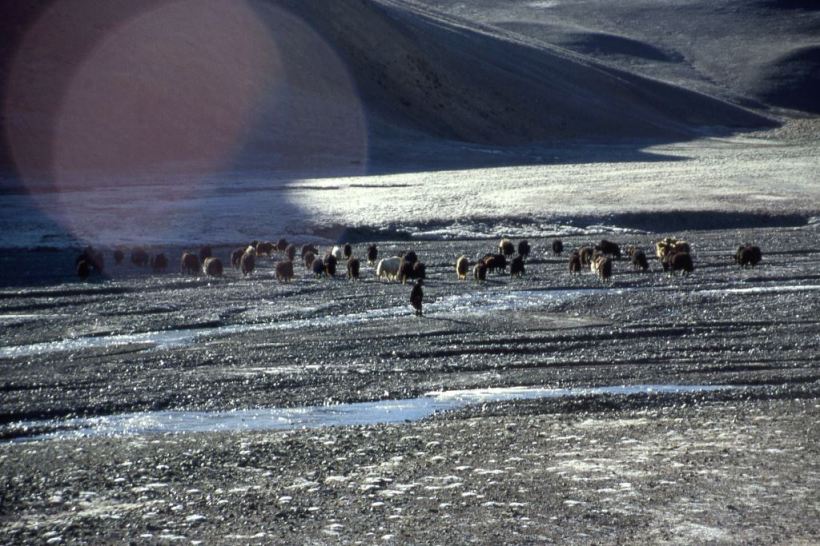
So I just bought a scanner to scan the many pictures I have from my stay in Tibet in 2000 and 2001. While I spent most of my time in the capital, Lhasa, I have yet to get to those pictures. Consequently, I have selected a few pictures showing some aspects of the daily life of the nomads in the Aru Basin. Continue reading “Tibetan lives: Nomads in the Aru Basin”
Why Herd Size Matters – Mitigating the Effects of Livestock Crashes
Just got a paper published in PLOS ONE. Basically, it provides the rationale for why it pays off for pastoralists to keep large herds of livestock. Continue reading “Why Herd Size Matters – Mitigating the Effects of Livestock Crashes”
Climate Change, Risk Management and the End of Nomadic Pastoralism

While not a particularly good quality map, it at least show the area my latest publication pertains to (Aru Basin). It is published in the journal International Journal of Sustainable Development & World Ecology.
The topic of the paper is mobility, a classic pastoral stagey for dealing with environmental variation. Mobility is used to manage resource variability, for example, during droughts where pastoralist have moved from affected areas to unaffected (or less affected) areas. Continue reading “Climate Change, Risk Management and the End of Nomadic Pastoralism”
Climate Change and Displacement for Indigenous Communities in Arctic Scandinavia
A paper written for the Brookings Institute, by Ilan Kelman and Marius Warg Næss. The paper can be found here.
 Pastoralism, Climate Change and Policy