Last week I got the news that I got a 4 year research grant funded by the Research Council of Norway.
Continue reading “HIERARCHIES: New research project from the Research Council of Norway”
Last week I got the news that I got a 4 year research grant funded by the Research Council of Norway.
Continue reading “HIERARCHIES: New research project from the Research Council of Norway”
Predatory species compete with humans for the use of resources such as livestock and an important tool for managing possible conflicts is damage compensation schemes distributing the costs between those who benefit from conservation and those who suffer the costs of damage.
The city of Lhasa lies at around 3650 meters. Lhasa consists of two quite distinctive parts: one part is primarily Tibetan and centers around the Jokhang Temple, which is the most holy site in all of Tibet. Continue reading “Tibetan lives: Lhasa”
Just got a paper published in Ecology and Evolution. It is basically about reindeer life history and risk sensitivity. Continue reading “Risk-sensitive reproductive allocation: fitness consequences of body mass losses in two contrasting environments”
Herskovits[1] showed that cattle were a dominant element among East African pastoralists’ culture and life. Cattle were important in many ways, e.g. as a symbol of wealth, dowry, and in ceremonies. Continue reading “Are Nomadic Pastoralists Non-Rational?”
Continue reading “Nomadic Pastoralism: Importance and Distribution”
In the early days, research was all about establishing typologies. So also in the study of nomadic pastoralism, which was concerned with establishing typologies of “pure pastoralists or nomads” where the units of analysis were “ideal types”[1]. Continue reading “Nomadic Pastoralism: A (Tentative) Definition”
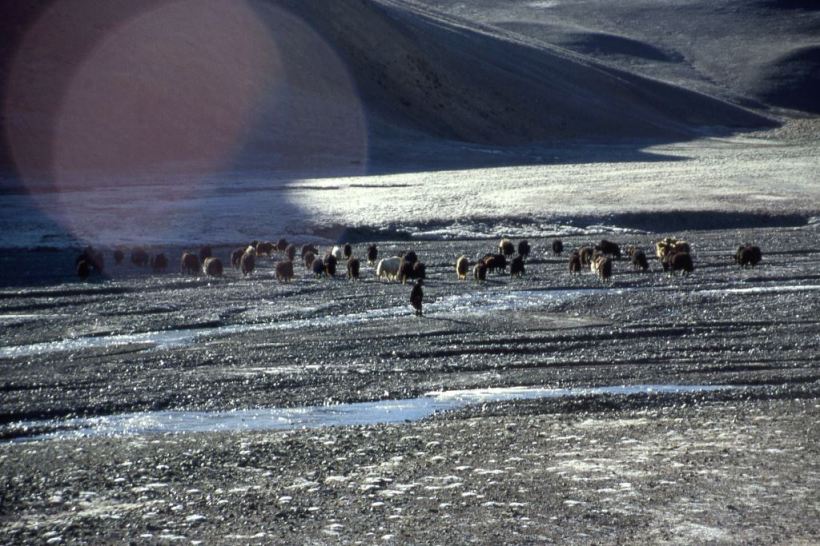
So I just bought a scanner to scan the many pictures I have from my stay in Tibet in 2000 and 2001. While I spent most of my time in the capital, Lhasa, I have yet to get to those pictures. Consequently, I have selected a few pictures showing some aspects of the daily life of the nomads in the Aru Basin. Continue reading “Tibetan lives: Nomads in the Aru Basin”
Just got a paper published in PLOS ONE. Basically, it provides the rationale for why it pays off for pastoralists to keep large herds of livestock. Continue reading “Why Herd Size Matters – Mitigating the Effects of Livestock Crashes”

While not a particularly good quality map, it at least show the area my latest publication pertains to (Aru Basin). It is published in the journal International Journal of Sustainable Development & World Ecology.
The topic of the paper is mobility, a classic pastoral stagey for dealing with environmental variation. Mobility is used to manage resource variability, for example, during droughts where pastoralist have moved from affected areas to unaffected (or less affected) areas. Continue reading “Climate Change, Risk Management and the End of Nomadic Pastoralism”
 Pastoralism, Climate Change and Policy